

Proofhouse
The proof layer for AI-assisted operations.
Proofhouse connects workflow context, readiness, analysis, incident memory, and governance so teams can automate consequential workflows without losing evidence, review states, or ownership. The first proof path is a guided implementation: one workflow slice, one owner, one normal path, and one exception path.
Point automation can move work faster. Systems of record can store the final business record. The gap is the QC layer between them: what evidence was used, which checks passed, which cases needed review, what failed, and what should improve next.
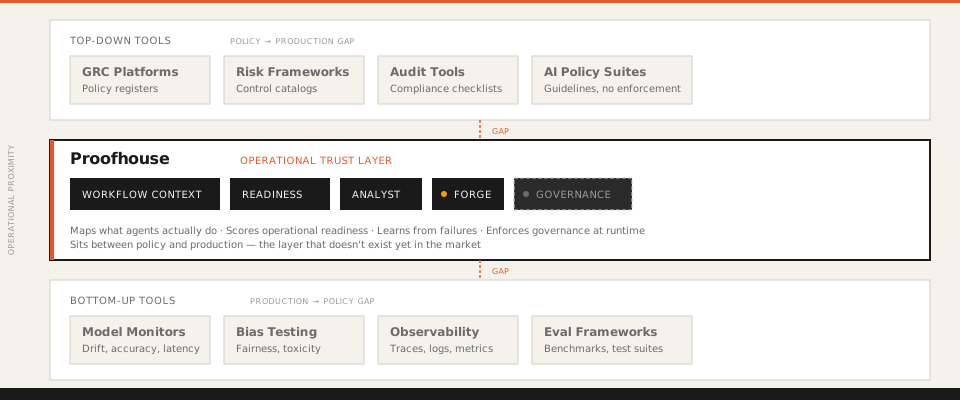
Teams still move work across systems, portals, queues, inboxes, and review loops while trying to preserve the context behind each decision.
Sits underneath the workflow as the durable proof layer — the audit-grade operating record between point automation above and systems of record beside it. Captures context and source evidence, scores readiness, routes exceptions, captures failures, and produces the evidence record that has to stand up later.
AI agents, RPA, IDP, and point automation can move work faster, but regulated teams still need evidence, review states, exception handling, and workflow ownership.
The app layer can be flexible. The proof layer has to be durable.
As AI makes workflow-specific interfaces easier to create, the hard problem moves below the screen. Consequential work still needs a durable operating record — evidence, review state, exceptions, approvals, controls, and audit. Proofhouse is built for that layer.
Read the thesisWORKFLOW CONTEXT
ACTIVECaptures how the operational workflow actually runs so the rest of the platform has a grounded, queryable operating record.
WORKFLOW OBJECTS
Create a live model of the workflow, not just a pile of tasks or source files.
OWNERSHIP + ESCALATION
Keep named owners, escalation paths, and approvals attached to the work.
REQUIRED INPUTS
Track the inputs, records, decisions, and destination systems each case depends on.
EVIDENCE + APPROVALS
Preserve source refs, review history, supporting records, and decision evidence.
SIGNALS + EXCEPTIONS
Track missing information, conflicting records, low-confidence outputs, and weak handoffs.
CONNECTORS + GROUNDING
Pull context from the systems, portals, documents, and knowledge the workflow already depends on.
ANALYST
ACTIVEMakes the operating record accessible to workflow owners, operators, and compliance teams who need answers without rebuilding context manually.
ANALYST Q&A
Ask what happened, what needs review, which evidence supports a decision, and what is blocked.
BRIEFINGS + REPORTS
Generate review-ready summaries and evidence packets without rebuilding context manually.
RISK SURFACING
Surface missing information, escalation pressure, control gaps, and recurring exception patterns.
READINESS
ACTIVEAnswers which parts of the workflow are ready for automation, which require review, and which are blocked.
WORKFLOW STABILITY
Measure repeatability, reversibility, and exception pressure inside the workflow.
DEPENDENCY RESILIENCE
Expose fragile portals, destination systems, handoffs, and downstream dependencies early.
OVERSIGHT + OWNERSHIP
Check for named owners, escalation paths, override rights, and fallback modes.
CONTROL READINESS
Assess whether approvals, logs, and decision records exist where they need to.
AUTOMATION FIT
Separate safe, repeatable tasks from high-impact work that still needs tighter controls.
TRUST-GAP DIAGNOSIS
Turn weak spots into a clear explanation of where the workflow is most exposed.
REMEDIATION PRIORITIES
Rank the fixes that most improve readiness before the next stage of scale.
READINESS ROLLUPS
Roll workflow findings into a broader operating picture without losing local detail.
FORGE
OPEN COREEnsures the organization learns from workflow failures, routing misses, missed escalations, and recurring exception patterns.
INCIDENT RECORDS
Capture structured incidents tied to the workflow, subject, evidence, and review path involved.
FAILURE TAXONOMY
Classify context, routing, review, evidence, escalation, and redaction failures.
PATTERN ANALYSIS
Identify recurring failure modes across incidents, workflows, case types, and time.
PLAYBOOK GENERATION
Generate response playbooks from analyzed patterns and prior resolutions.
Open-core release: reusable tooling and schemas are public; live incident corpora and proprietary learnings stay private.
VIEW FORGE ON GITHUBGOVERNANCE
BETAThe governance kernel for review-required decisions, rights and redaction posture, approval records, and evidence operations. Substantially implemented and in internal evaluation — not yet a customer-ready, GA runtime control plane.
POLICY LIFECYCLE
Author, publish, version, and govern policy bundles with clear approval lineage.
CONTROL EVALUATION
Run deterministic review-required logic against workflow events, routing steps, and use approvals.
EVIDENCE OPERATIONS
Record evidence, lineage, redaction posture, audit-packet manifests, and delivery artifacts for governed operations.
Maturity snapshot (June 2026): policy lifecycle, deterministic control evaluation, audit-packet ledger-chain verification, claims controls, and durable use-approval records are implemented and in internal evaluation; live customer activation and GA hardening are still ahead.
OPERATIONAL LEARNING
EARLY / BY DESIGNThe designed path that turns approved workflow activity into private evaluation and improvement assets — governed by rights, redaction, and use-approval. It exists to make the operation compound, not to create a training-data marketplace.
ASSET BUNDLES
Turn approved workflow activity into private evaluation and improvement assets — pointer-only by contract, never raw source payloads.
USE-APPROVAL GOVERNANCE
Bind rights, redaction, and named-recipient or use-class constraints to every asset through Governance.
PROMOTION CONTROL
Gate what may move beyond an evidence-only posture, with promotion denied until a use approval exists for the exact use class.
By design and early: assets are synthetic and pointer-only, live customer activation is denied by default, and no asset moves beyond evidence-only posture without a Governance use approval for the exact use class.
Integrated through shared workflow context
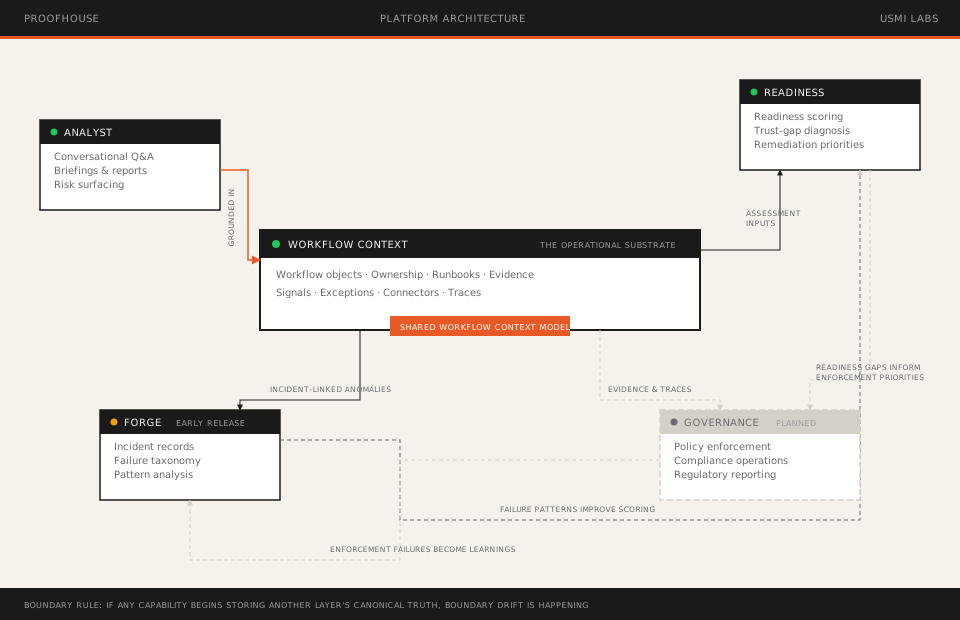
BOUNDARY RULE: IF ANY CAPABILITY BEGINS STORING ANOTHER LAYER'S CANONICAL TRUTH, BOUNDARY DRIFT IS HAPPENING.
Regulated AI adoption is an operational evidence problem. Some obligations are already enforced; others arrive on a moving timeline. Proofhouse is designed to produce the workflow-native evidence these regimes ask for — and we make specific framework-coverage claims only where implementation mapping exists.
42 CFR Part 2 consent and redisclosure controls (Feb 2026, including billing vendors); Freddie Mac Bulletin 2025-16 AI/ML governance expectations (Mar 2026); CMS-0057-F prior-authorization requirements (Jan 2026); HIPAA §164.312(b) audit controls.
EU AI Act: transparency obligations from 2026, high-risk obligations phasing in from December 2027 (Digital Omnibus). Colorado's AI framework takes effect January 1, 2027.
Whatever the final rulebooks say, they converge on the same requirement: independent audits, incident reporting, and evidence of what the AI actually did.
Proofhouse produces that evidence at the workflow level and feeds it upstream to whatever GRC or control-tower system you already run. We claim framework coverage only where it is implemented.
Start with one workflow slice, one owner, and a review loop you can prove.
We help teams scope and implement the first controlled workflow slice where automation has to preserve evidence, exception discipline, and human accountability from the start.
ASSESS A WORKFLOW