

USMI LABSSN. 001

Workflow evidence and control for
AI-assisted operations.

Proofhouse pairs guided implementation of one controlled workflow slice with the evidence and control layer needed to trust it: map the work, preserve source evidence, check required inputs, route exceptions, capture failures, and govern how workflow-derived learning is used.

STATUS: OPEN TO GUIDED IMPLEMENTATION INQUIRIES
GUIDED IMPLEMENTATIONGOVERNED IMPROVEMENT

PROOFHOUSE PLATFORM

Five capability layers around one governed operational workflow.

WORKFLOW CONTEXTACTIVE

Model the operational workflow: inputs, source evidence, destination systems, owners, review states, and escalation paths.

ANALYSTACTIVE

Give operators a workflow-scoped interface to ask what happened, what needs review, where evidence lives, and which cases are blocked.

READINESSACTIVE

Score which steps are automation-safe, review-required, escalation-required, or blocked before the workflow is scaled.

FORGEOPEN CORE

Open-core incident memory for workflow failures, routing misses, missing evidence, reviewer disagreements, and recurring exception patterns.

GOVERNANCEEARLY IMPLEMENTATION

Early implementation of review-required decisions, rights checks, redaction posture, approval records, and evidence operations.

INTEGRATED THROUGHSHARED WORKFLOW CONTEXT

One interface organized around workflow context, evidence, review states, incidents, controls, and readiness - not separate products.

EXPLORE THE PLATFORM

PROOFHOUSE IS THE GOVERNED WORKFLOW LAYER AROUND AI-ASSISTED OPERATIONS - NOT A GENERIC AGENT WRAPPER OR COMPLIANCE REPLACEMENT.

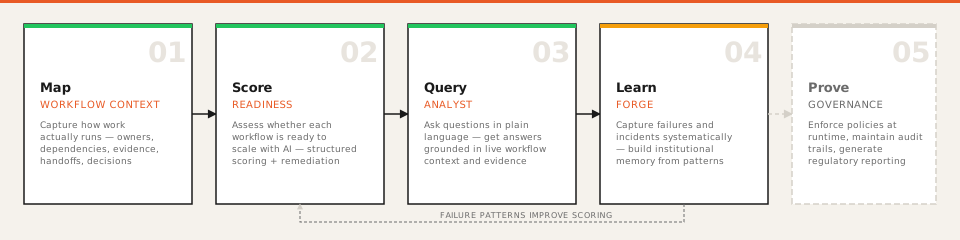
THE PROOFHOUSE LIFECYCLE

Five capabilities. One governed workflow.

Every Proofhouse engagement follows the same operational arc: map the workflow, preserve source evidence, score readiness, route exceptions, learn from failures, and build the evidence base needed for review and oversight.

Proofhouse lifecycle: map workflows, score readiness, query with Analyst, learn from failures with Forge, and support governed operations with Governance
EACH CAPABILITY FEEDS THE NEXT - SHARED WORKFLOW CONTEXT IS THE SUBSTRATEEXPLORE THE PLATFORM →
USE CASES
FEATURED DEEP DIVE

Regulated document operations

The first Proofhouse use-case deep dive focuses on guided implementation for document-heavy workflows where teams still read source files, enter data into systems, chase missing information, and preserve review evidence. It is a proof path, not the full category.

VIEW DEEP DIVE
BROADER PATTERNS

Review and escalation workflows

Workflow readiness diagnostics

Incident and failure learning

Governance and evidence operations

EXPLORE USE CASES
HOW IT WORKS

Start with one workflow slice.
Build confidence from there.

We work with teams where AI-assisted work needs ownership, QC-style checks, review states, exception handling, and an evidence trail. Engagements begin as a guided implementation of the smallest useful workflow slice, then expand only when the controls are working.

01

ASSESS

Choose the First Slice

Start with one operational workflow, one owner, one normal path, one exception path, and a clear reason the workflow is worth improving.

02

IMPLEMENT

Build the Controlled Flow

Connect the source inputs, required fields, destination handoff, validation checks, review states, and case-level operating context.

03

CONTROL

Route Work and Exceptions

Move clean cases forward and route missing, conflicting, low-confidence, or policy-sensitive cases to the right human review point.

04

LEARN

Review, Govern, Improve

Preserve decisions, incidents, and evidence packets so teams can improve the workflow without turning production work into uncontrolled training data.

ENGAGEMENTS START WITH ONE WORKFLOW, ONE OWNER, AND A CLEAR REVIEW LOOP
WHY PROOFHOUSE
01

CHECK AUTOMATED WORK BEFORE IT SCALES

Apply QC-style checks to source inputs, extracted fields, validation results, review states, and exception paths so automation stays inspectable.

02

MAKE EXCEPTIONS EXPLICIT

Route missing, conflicting, low-confidence, or policy-sensitive cases to the right owner instead of hiding edge cases inside automation.

03

BUILD THE OPERATING RECORD

Keep workflow context, routing outcomes, incidents, and readiness posture visible so owners can scale with control.

OPERATING MODEL
CAPABILITY
SPEC
OUTPUT
WORKFLOW SLICE
ONE PROCESS + OWNER
CLEAR PILOT SCOPE
SOURCE EVIDENCE
INPUTS + DECISION REFS
REVIEWABLE OUTPUTS
EXCEPTION ROUTING
MISSING + CONFLICTING CASES
HUMAN REVIEW POINTS
READINESS
SAFE + REVIEW-REQUIRED STEPS
BETTER AUTOMATION FIT
CONTROL
APPROVALS + AUDIT RECORDS
OVERSIGHT BY DEFAULT
ENGAGEMENT MODEL
EARLY COLLABORATIONS + OPEN INQUIRIES
HIGH-TOUCH
PLATFORM
PROOFHOUSE - 5 CAPABILITY LAYERS
UNIFIED
REV. 2026.04PROOFHOUSE OPERATING SNAPSHOT
RESEARCH

The deeper thinking behind the work.

Research is where we go deeper on the operating thesis behind Proofhouse: readiness, governance, failure analysis, and the workflow conditions that make AI-assisted operations reviewable.

THESIS 0014 min read

The USMI Thesis

AI adoption does not usually stall because companies lack tools. It stalls when teams add speed before they have the context, visibility, and operational readiness to absorb it.

ThesisOperationsAI Adoption
FIELD NOTE 0025 min read

Why AI Adoption Fails in Operations

Most AI rollouts fail for boring reasons: fragmented context, weak ownership, poor workflow fit, and no clear way to tell whether the new system is improving the business or just adding noise.

Field NotesWorkflow DesignAdoption
RESEARCH NOTE 0035 min read

Governance, Readiness, and Trust in Growing Companies

Governance for growing companies should not read like enterprise bureaucracy. The real job is to create enough structure that AI can be useful, reviewable, and scalable without slowing the business to a halt.

GovernanceReadinessTrust
PLATFORM NOTE 0046 min read

The Proofhouse Platform

Proofhouse does not treat workflow context, readiness, failure learning, and governance as one monolithic capability. They are distinct jobs — tightly integrated through shared workflow context, but with clear boundaries.

ProofhouseTrustPlatform Architecture

RESEARCH IS THE THESIS LAYER BEHIND PROOFHOUSE

View All Research
AI-ASSISTED WORKFLOWS NEED OPERATING PROOF

Start with one controlled workflow implementation.

We help scope the first AI-assisted workflow slice, then use Proofhouse to preserve source evidence, route exceptions, and keep the workflow owner in control.

ASSESS A WORKFLOW