THESIS 0014 min read
The USMI Thesis
AI adoption does not usually stall because companies lack tools. It stalls when teams add speed before they have the context, visibility, and operational readiness to absorb it.
ThesisOperationsAI Adoption


Proofhouse is the operational trust platform for AI agents. It maps workflows, scores readiness, captures failure patterns, and builds the evidence base that proves your operations are trustworthy.
START A CONVERSATIONFive capability layers. One operational trust surface.
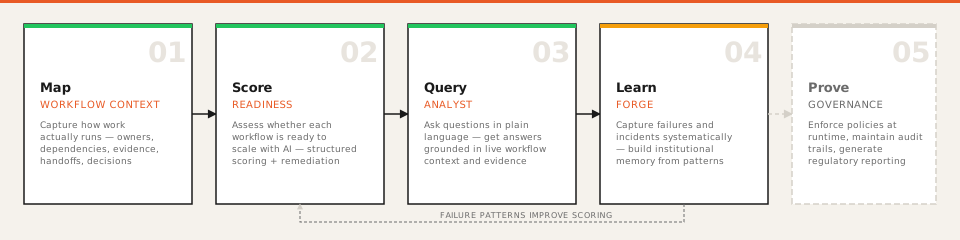
Map how AI-enabled workflows actually run — ownership, dependencies, evidence, traces, handoffs, and decisions.
Give operators and compliance teams a conversational interface to query workflow state, generate reports, and surface risks.
Score whether a workflow is prepared to scale with AI, identify trust gaps, and prioritize remediation.
Capture incidents and recurring failure patterns, building institutional memory that improves reliability over time.
Runtime policy enforcement, auditable compliance operations, and regulatory reporting aligned to EU AI Act, NIST AI RMF, and ISO 42001.
One interface organized around workflows, incidents, controls, evidence, and readiness — not separate products.
EXPLORE THE PLATFORMPROOFHOUSE SITS BETWEEN POLICY AND PRODUCTION — THE OPERATIONAL MIDDLE LAYER FOR AI AGENT TRUST.
Every Proofhouse engagement follows the same operational arc: map how work actually runs, score its readiness for AI, give teams a way to query and monitor, learn from failures, and build the evidence base to prove compliance.
We work with organizations deploying AI agents in consequential workflows. Engagements start by clarifying the workflow, the context behind decisions, and the places where scale creates friction.
We find the handoffs, decisions, and pressure points where new AI tooling will either save time or create confusion.
We organize the documents, metrics, and operating knowledge teams and tools need to work from the same context.
Proofhouse capabilities fit into live operating rhythms so trust infrastructure shows up where teams already work, not in a side demo.
We review outcomes, bottlenecks, and adoption patterns so teams can scale with more confidence and less rework.
Know what your AI agents are actually doing — workflows, ownership, evidence, decisions, and handoffs — grounded in live context, not assumptions.
Surface trust gaps, fragile handoffs, missing controls, and dependency risk before added speed turns into rework or audit exposure.
Capture failure patterns, maintain audit trails, and produce the compliance evidence that proves your AI operations are trustworthy.
Research is where we go deeper on the operating thesis behind Proofhouse: readiness, governance, failure analysis, and the operational conditions that make AI agent deployments trustworthy.
AI adoption does not usually stall because companies lack tools. It stalls when teams add speed before they have the context, visibility, and operational readiness to absorb it.
Most AI rollouts fail for boring reasons: fragmented context, weak ownership, poor workflow fit, and no clear way to tell whether the new system is improving the business or just adding noise.
Governance for growing companies should not read like enterprise bureaucracy. The real job is to create enough structure that AI can be useful, reviewable, and scalable without slowing the business to a halt.
Proofhouse does not treat workflow context, readiness, failure learning, and governance as one monolithic capability. They are distinct jobs — tightly integrated through shared workflow context, but with clear boundaries.
RESEARCH IS THE THESIS LAYER BEHIND PROOFHOUSE
View All ResearchProofhouse makes operational trust infrastructure — so you can deploy AI agents with context, readiness, and evidence from day one.
START A CONVERSATION